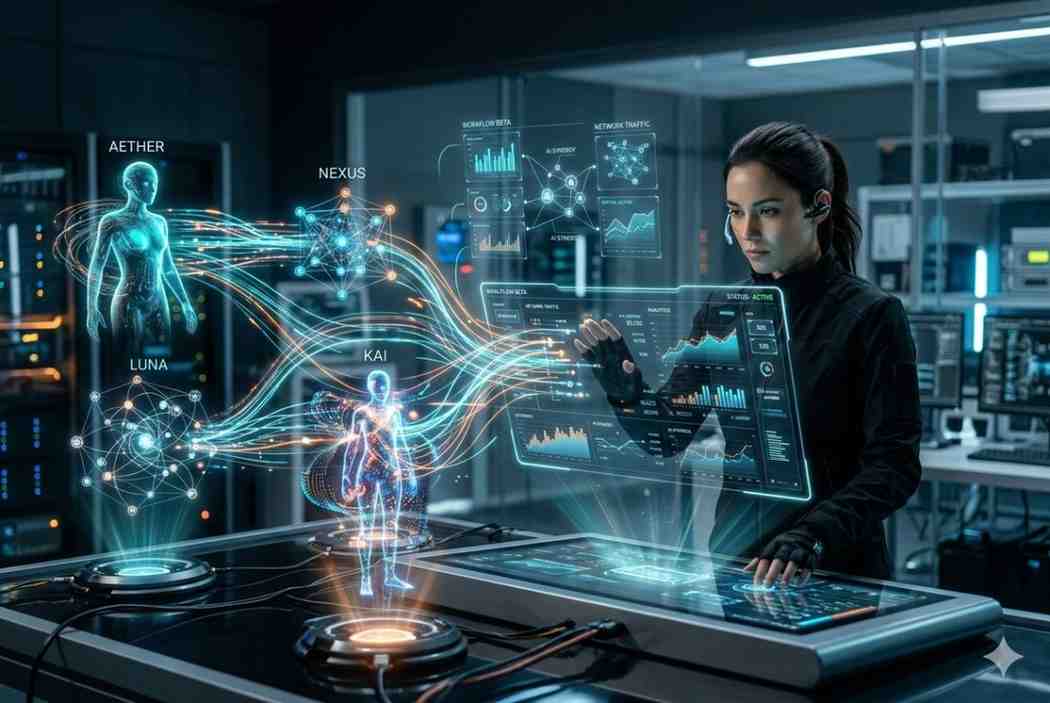
In today’s world of artificial intelligence, robotics, and complex simulations, Multi-Agent Systems (MAS) are becoming increasingly important. These systems allow multiple intelligent agents to interact, cooperate, or compete to achieve individual or shared goals, making them essential for solving complex, real-world problems that are difficult for a single agent or program to handle.
What Is a Multi-Agent System?
A Multi-Agent System is a system composed of multiple interacting agents. An agent is an autonomous entity capable of perceiving its environment, reasoning, and acting to achieve objectives. In MAS, agents can be:
- Cooperative: working together toward a common goal.
- Competitive: acting in opposition to other agents.
- Hybrid: mixing cooperation and competition depending on context.
By distributing tasks among multiple agents, MAS can handle large-scale, dynamic, and complex environments efficiently.
Key Components of Multi-Agent Systems
- Agents: The decision-making entities, which can be software programs, robots, or virtual characters.
- Environment: The space or context in which agents operate and interact.
- Communication: Protocols for agents to exchange information, coordinate, or negotiate.
- Coordination & Control: Strategies to manage conflicts, distribute tasks, and ensure system-wide goals are met.
- Goals & Behaviors: Individual or collective objectives that guide agent actions.
How Multi-Agent Systems Work
MAS relies on distributed intelligence, where agents individually perceive, reason, and act, but also coordinate with others:
- Perception: Agents sense the environment and other agents.
- Decision-Making: Each agent evaluates its goals and chooses an action based on its knowledge and strategy.
- Communication: Agents share information to reduce uncertainty and optimize collective behavior.
- Action & Adaptation: Agents act on the environment and adapt to changes, learning from interactions.
This combination of autonomy, interaction, and adaptability is what makes MAS powerful for complex tasks.
Applications of Multi-Agent Systems
- Robotics: Coordinating fleets of drones, autonomous vehicles, or warehouse robots for tasks like delivery, mapping, or surveillance.
- Traffic & Transportation: Optimizing traffic flow with intelligent traffic lights, smart cars, and route planning.
- Simulation & Gaming: Creating realistic virtual environments with agents representing humans, animals, or entities.
- Smart Grids & Energy Systems: Balancing energy supply and demand using intelligent agents for sustainable power distribution.
- Healthcare: Coordinating patient care, resource allocation, and intelligent monitoring systems.
- Finance: Agents simulating market participants to predict trends or manage algorithmic trading.
Advantages of Multi-Agent Systems
- Scalability: Easily handles large, complex problems by distributing tasks among agents.
- Robustness: Failure of one agent doesn’t compromise the entire system.
- Flexibility: Agents can adapt to dynamic environments and changing goals.
- Parallelism: Multiple agents operate simultaneously, improving efficiency.
Challenges and Considerations
- Coordination Complexity: Managing interactions among many agents can be difficult.
- Communication Overhead: Too much communication can slow down the system.
- Conflict Resolution: Agents may have conflicting goals, requiring robust negotiation strategies.
- Security Risks: Malicious agents can disrupt the system or exploit vulnerabilities.
Future of Multi-Agent Systems
The future of MAS looks promising, especially when combined with machine learning and AI planning:
- Collaborative AI: Multiple AI systems working together in real-time for decision-making.
- Smart Cities: Coordinated agents managing traffic, utilities, and emergency response.
- Autonomous Vehicles: Swarms of self-driving cars communicating to optimize traffic and safety.
- Complex Simulations: Modeling ecosystems, economies, or social behavior with intelligent agents.
MAS represents a fundamental shift in problem-solving: rather than relying on a single, centralized intelligence, distributed autonomous agents collaborate to solve complex, dynamic, and large-scale problems.
Conclusion
Multi-Agent Systems are revolutionizing the way we approach complex problems across industries. By enabling distributed, autonomous, and collaborative intelligence, MAS provides scalable, flexible, and robust solutions for real-world challenges.
From traffic optimization to autonomous fleets, from smart grids to gaming simulations, MAS is not just a research concept—it’s a practical framework shaping the future of AI and automation.